
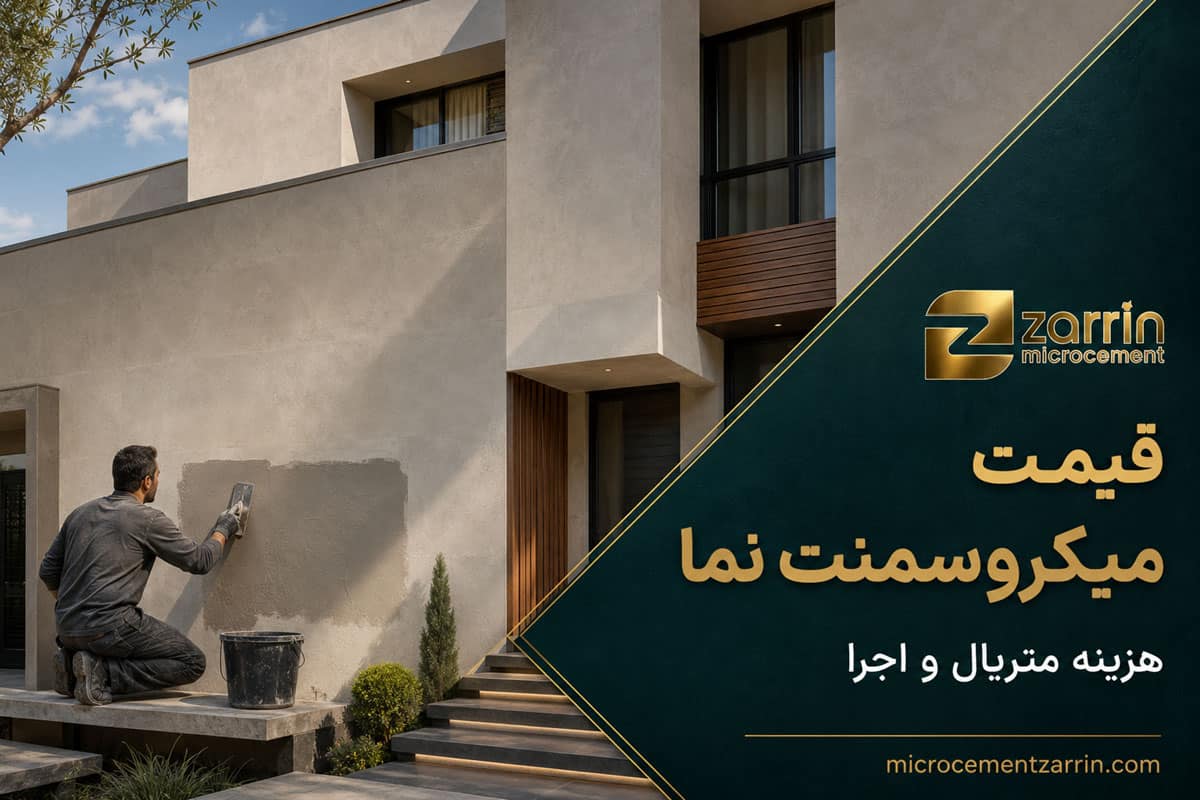
Designing a building façade with modern, seamless microcement has become one of the most popular choices among architects. However, the first and most important question for property owners is always: How much does a microcement façade cost?
Unlike interior applications, the cost of installing microcement on exterior façades depends on several unique factors, including the complexity of working at height, the need for scaffolding, waterproofing layers, UV-resistant protective coatings, and the quality of the existing substrate.
In this guide by Zarrin Microcement, we provide a professional breakdown of the average microcement façade price per square meter and examine every factor that affects the final project cost.
How Much Does Microcement Façade Installation Cost? (General Price Estimate)
Before reviewing installation costs, it is helpful to understand **what microcement is**, as this provides a clearer understanding of its structure, performance, and the reasons behind price differences.
The total cost of a microcement façade generally consists of two main parts: **material costs** and **installation labor**. In general, the price per square meter of a microcement façade in 2026 varies depending on the type of material, substrate condition, and accessibility to the installation area. Before making any decision, it is essential to request a detailed quotation from a professional contractor, as every project has unique requirements.
Outdoor Microcement Material Prices (UV & Moisture Resistant)
For exterior façades, only materials that are resistant to **UV radiation, moisture, and temperature fluctuations** should be used. According to the **Zarrin Microcement Price List – August 2026**, the base material prices are as follows:
| Product | Price (Toman/kg) |
|———|—————–:|
| Single-Component White Base Powder | 420,000 |
| Single-Component White Fine Powder | 440,000 |
| Single-Component Porcelain-Colored Fine Powder | 490,000 |
| Water-Based Primer | 400,000 |
One of the key advantages of Zarrin Microcement products is that after applying three coats, **no additional primer is required** before the final industrial protective coating. This results in a smooth, seamless finish with no roller marks while reducing both installation time and overall project costs.
Microcement Installation Labor at Height (Scaffolding & Safety Costs)
Installing microcement on building façades involves additional expenses compared to interior applications, including:
– Scaffolding:** Calculated separately based on building height and total surface area.
– Safety Equipment:** Certified safety harnesses, ropes, and other protective equipment are mandatory for working at height.
– Installation Time:** Working at height slows the installation process, resulting in higher labor costs.
For these reasons, façade installation labor is typically more expensive than interior applications and should always be calculated separately in the project quotation.
What Factors Affect the Final Cost of a Microcement Façade?
The quality of installation and the long-term durability of the project largely depend on choosing the right type of microcement for exterior façades.
The final cost of a microcement façade is not determined by material prices alone. Factors such as the condition of the existing substrate, building height, project size, architectural complexity, the type of protective coating, and site accessibility all have a significant impact on the total cost. To estimate the real cost of a microcement façade, all of these variables must be considered together.
How the Existing Façade Surface Affects the Cost
Proper surface preparation is the foundation of a successful microcement installation.
Smooth cement façades require the least amount of preparation.
Brick façades usually need additional joint filling and leveling.
Old or damaged façades may require crack repair and surface restoration before installation, increasing the overall project cost.
According to Zarrin Microcement, using a high-quality water-based primer during substrate preparation is essential for achieving long-lasting performance.
The Role of Protective Polyurethane Coatings
A UV-resistant polyurethane topcoat is the most important layer protecting exterior microcement against sunlight, rain, humidity, and temperature changes.
Although this protective coating adds to the initial installation cost, it can extend the lifespan of the façade to 15–20 years. Zarrin Microcement’s high-performance coating system minimizes maintenance requirements and eliminates the need for frequent restoration.
Project Size & Architectural Complexity
Larger projects often benefit from volume discounts.
However, curved surfaces, decorative architectural details, and complex façade designs require additional craftsmanship, increasing labor costs. Villas and modern architectural façades that combine microcement with materials such as natural stone or wood also require more installation time.
For an accurate quotation, the project drawings and façade photographs should always be reviewed by the technical team.
Microcement vs. Traditional Façade Materials
Choosing an exterior finish should not be based solely on its purchase price. Structural load, maintenance costs, and service life are equally important.
Façade Material | Approximate Cost | Structural Weight | Maintenance
Microcement | Medium | Very Low | Easy
Travertine Stone | High | High | Moderate
Facing Brick | Medium to High | High | Requires Repointing
Aluminum Composite Panels | High | Medium | Moderate
Dead load refers to the permanent weight that construction materials impose on the building structure.
One of the biggest advantages of exterior microcement is its seamless finish and extremely low structural weight compared to traditional façade systems.
Is Microcement More Affordable Than Travertine?
In terms of total project cost, microcement is often the more economical solution because it:
Eliminates heavy steel framing and stone support systems.
Significantly reduces the building’s structural load.
Requires no grout joints or periodic joint repairs.
Can often be applied directly over existing façades without complete demolition.
Microcement vs. Washed Cement & Thermowood
From a long-term investment perspective:
Compared to washed cement: More design flexibility, wider color options, and better crack resistance.
Compared to thermowood: No annual oil treatment, no moisture-related decay, and lower maintenance requirements.
Easy to clean, highly durable, and protected by UV-resistant polyurethane coatings.
Why Is Investing in a Microcement Façade a Smart Decision?
Why Is Investing in a Microcement Façade a Smart Decision?
When investing in your building’s façade, you’re not only paying for aesthetics—you should also consider the long-term return on your investment. From day one, a microcement façade helps eliminate many of the hidden costs commonly associated with natural stone or brick façades.
Significant Reduction in Structural Dead Load and Construction Costs
Every square meter of travertine stone weighs approximately 50–70 kg, while microcement weighs only 3–5 kg.
This makes microcement an ideal solution for renovation projects, older buildings, or lightweight structures, as it reduces the need for wall reinforcement, additional steel framing, or deeper foundations.
For a 200-square-meter project, the reduced structural weight can save a substantial amount on steel and concrete costs.
Thanks to its lightweight composition and excellent adhesion, Zarrin Microcement can also be applied directly to existing concrete and steel structures without requiring heavy demolition or additional construction materials.
Low Maintenance Costs and Easy Cleaning
Natural stone façades typically require professional cleaning every year, and damaged stones often need to be replaced individually.
Microcement, on the other hand, can be cleaned easily using water and a pressure washer. Its protective coating resists dirt, moisture, and environmental pollutants.
Because the surface is completely seamless, there are no joints where water or dirt can accumulate.
Even after many years, renovation is simple—an additional layer of microcement can be applied directly over the existing surface without demolition or heavy scaffolding.
Over the long term, this can reduce façade maintenance costs by up to 50% compared to traditional exterior finishing materials.