The most common question clients ask is: “Give me a number, how much is it per meter?”
The honest answer is: There is no single figure. This isn’t because installers are being vague, but because the price of wall microcement is like the price of a car; the same model with different options has completely different price points. Two factors influence the calculation of microcement prices more than any other:
Surface Condition; The Achilles’ heel of costs (Plaster, cement, or tile?)
What is the current state of your wall?
If it has smooth, fresh plaster, the work proceeds simply. But if there is old tile on the wall, the surface is cracked, or it has moisture issues, the story changes. Before doing anything else, the installer must prepare the surface with fiberglass mesh and layers of putty; this stage takes time and adds a direct cost to the project.
Some professional brands, such as Zarrin Microcement, use specialized primers for adhesion on different surfaces, which increases execution safety but, naturally, also increases material costs.
A simple rule for initial estimation: The more complex the wall preparation is for microcement, the larger the share of your budget that will be spent on preparation, rather than the application itself.
The impact of square footage on wall microcement pricing; Why are small projects not calculated by the meter?
You might imagine that 5 meters of microcement should cost exactly half of 10 meters. But that is not the case.
The installer has a fixed cost for travel, tool setup, and their specialized time, which you pay regardless of the square footage. For this reason, projects smaller than 10 to 15 square meters are usually calculated as a total “project fee” rather than a per-meter execution price.
So, if you only have a small decorative wall, the price per meter may appear more expensive than a large project, while the logic behind it is perfectly understandable. For larger surfaces such as microcement facades, per-meter calculation is more common and cost-effective because a higher square footage is involved.
Estimating microcement costs for specific and decorative walls
An execution specialist usually provides a quote based on the type of microcement, the substrate, and the desired design, but what may not be seen at first glance is the quality of the execution. We recommend checking the executor’s previous portfolio while inquiring about the price. Always examine the quality of a few previous projects alongside checking the price of wall microcement and its application. The parameters below will help you get a better understanding of this process, and if needed, you can even call 09123135964 for a free expert consultation.
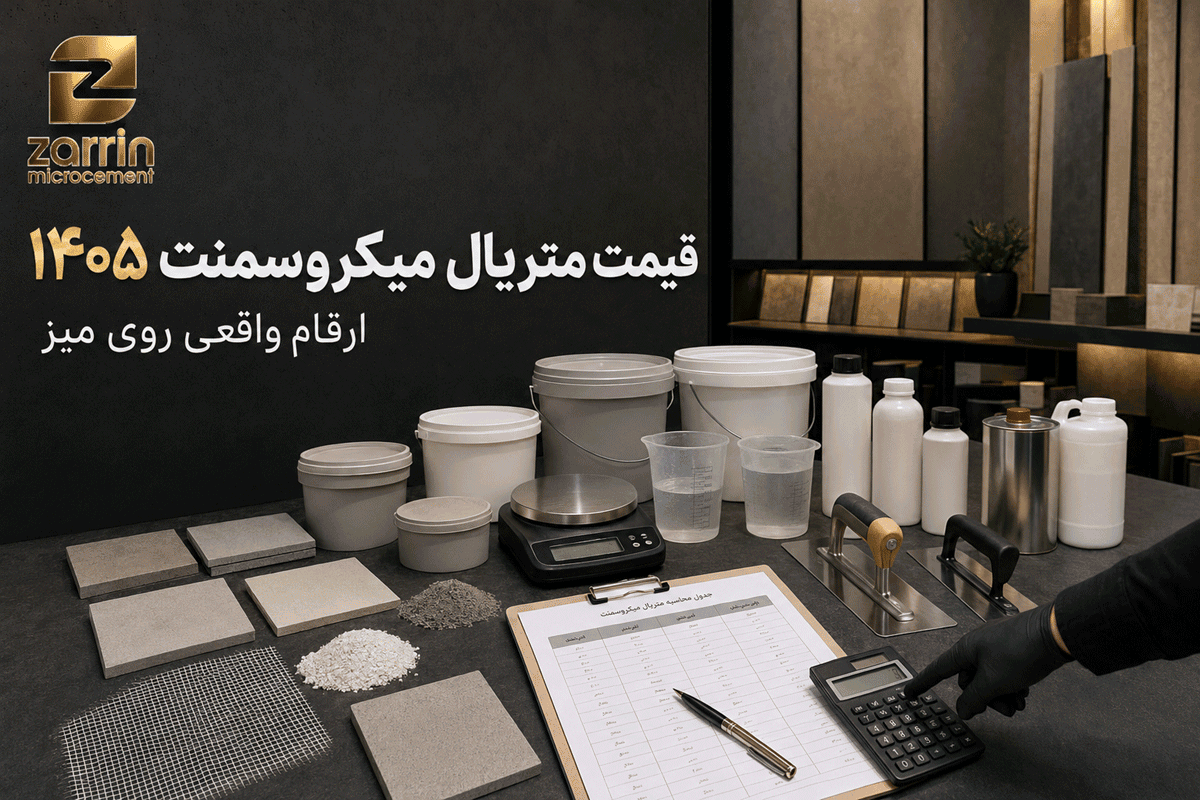
1405 Microcement Material Prices; Real Figures on the Table
One of the most effective things you can do before receiving a proforma invoice is to understand the cost of the materials yourself. When you know what the product is worth, you can more easily evaluate whether the installer’s proposal is reasonable.
Based on the 1405 Zarrin Microcement price list, the material costs are as follows:
| Product |
Price (Tomans/kg) |
| Water-based Substrate Primer |
400,000 |
| White Single-Component Powder Base |
420,000 |
| White Single-Component Powder Mid |
420,000 |
| White Single-Component Powder Fine |
440,000 |
| Porcelain Self-Color Base |
470,000 |
| Porcelain Self-Color Fine |
490,000 |
| Mud/Clay-Effect (Kargel) Microcement |
470,000 |
Standard wall microcement application usually involves several layers: primer, base, mid, and fine. Each layer consumes a certain amount of material; therefore, the total material cost for a 20-square-meter wall could be between 1 to 1.5 million Tomans for products alone. Labor costs, paint/pigment, and the final varnish are added to this figure.
An important note: As mentioned in the Zarrin Microcement list, after applying three layers of material, there is no need for re-priming on top of the microcement. This feature can save costs in renovation projects that involve multiple application stages.
Metallic and Effect Walls; Where Costs Jump
If you want your wall to have a metallic effect, rust look, or a specific texture, you must allocate a separate budget for special materials.
In the 1405 list, there are two special products for these types of executions:
- Iron Oxide with Iron Sulfate liquid (for rust and industrial aging effects): 2,500,000 Tomans
- Aluminum Micrometal (for metallic and sheen effects): 2,500,000 Tomans
These prices are roughly 5 to 6 times higher than base materials. So, if your interior designer has suggested a decorative or patterned wall with a metallic texture, know that the material cost for that wall alone can consume a significant portion of the budget.
Microcement for Facades; Why is its cost different from interior walls?
Microcement for facades is a completely different world from interior walls, which we have covered in a comprehensive article that you can check if needed. In outdoor spaces, the material must be resistant to UV radiation, moisture, freezing, and temperature changes.
This means:
- Materials must be specific to facades, not standard interior products.
- Final protective layers (varnish or sealer) are applied more expensively and thicker.
- Labor costs are usually higher due to working at heights or environmental conditions.
On the other hand, because facade project dimensions are usually larger, the price per square meter becomes more reasonable in larger volumes.
If you are planning for a building facade or semi-open spaces such as terraces and balconies, be sure to confirm that the selected product is approved for this use before choosing the material.
Execution Labor or Microcement Material Price? Exactly what is your money spent on?
Most people who receive a microcement proforma invoice for the first time are shocked by the total figure. The reason for this shock is usually one thing: they don’t know what components are hidden within that number.
The final cost of a wall microcement project consists of several independent parts:
| Row |
Cost Component |
Explanation |
| 1 |
Substrate Preparation |
Patina, mesh, crack repair |
| 2 |
Main Material |
Primer + Base + Mid + Fine |
| 3 |
Paint or Pigment |
Coloring or self-color product |
| 4 |
Final Coating |
Varnish, sealer, or waterproof coating |
| 5 |
Labor |
Expert installer, layering, troweling |
| 6 |
Side Costs |
Travel, packaging, site masking |
Which part has the largest share of the cost?
Contrary to popular belief, in small projects (under 20 meters), labor costs are often higher than material costs. In larger projects, this ratio becomes closer.
Why is labor expensive?
- Microcement application is skill-based and requires trained installers.
- Each layer must be executed and dried at a specific time; the work takes several days.
- A mistake in one layer can require the entire surface to be revisited.
- Specialized tools (trowels, sprayers, sanders) carry their own costs.
Microcement execution cost in bathrooms and restrooms; Why is it more expensive?
Bathroom walls have the highest unit cost among microcement applications. Reasons:
- Permanent humidity → Need for multi-layer waterproofing before and after execution.
- Confined space → Harder work, more time, higher labor costs.
- Corners and edges → Areas with high crack risk that must be executed with greater precision.
- Specialized varnish/sealer needs → Waterproof products are more expensive than standard coatings.
Comparison Table of Execution Cost by Application:
| Application |
Complexity |
Need for Waterproofing |
Relative Cost |
| Interior Dry Wall |
Medium |
No |
Base |
| Kitchen (Backsplash) |
Medium |
Limited |
Slightly Higher |
| Bathroom & Shower |
High |
Yes |
Higher |
| Restroom |
High |
Yes |
Higher |
| Microcement Facade |
Very High |
Yes + UV |
Highest |
Checklist: Prepare this information before getting a proforma invoice
To receive a more accurate proforma invoice, have the following items specified in advance:
With this information, any professional installer can provide a transparent and comparable proforma invoice.


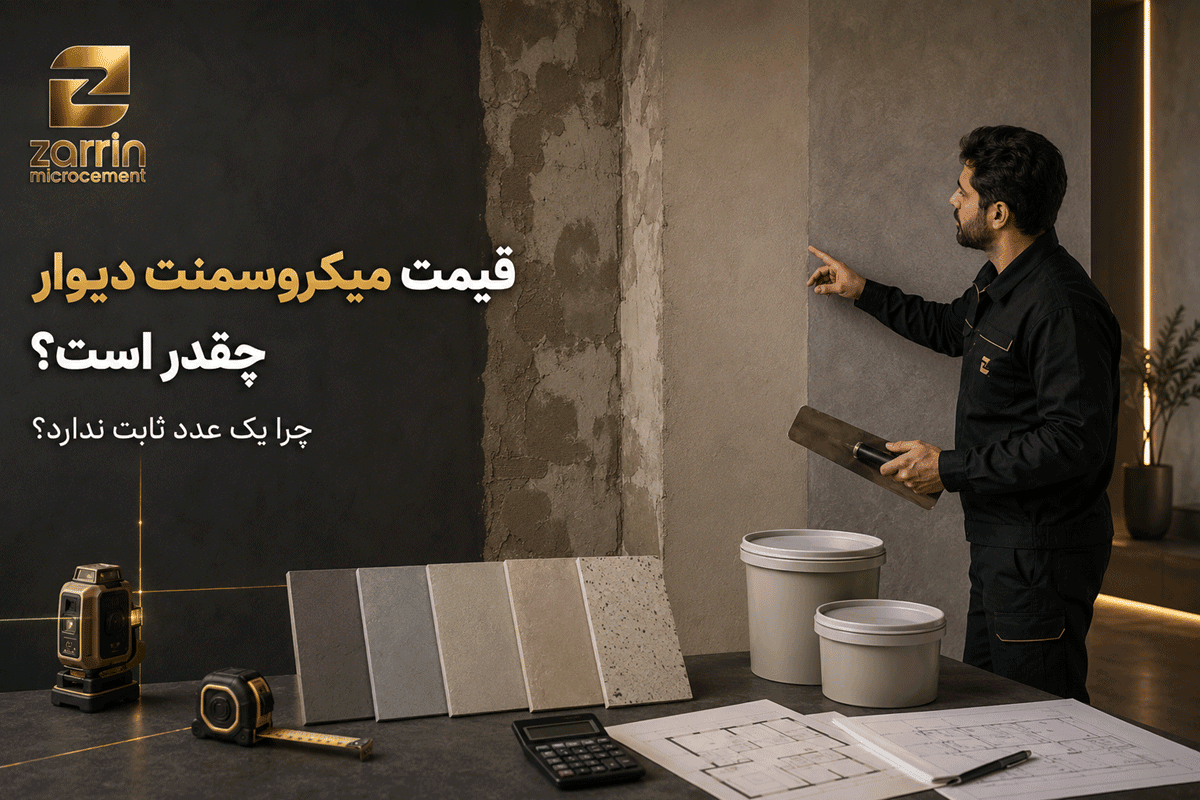 The most common question clients ask is: “Give me a number, how much is it per meter?”
The honest answer is: There is no single figure. This isn’t because installers are being vague, but because the price of wall microcement is like the price of a car; the same model with different options has completely different price points. Two factors influence the calculation of microcement prices more than any other:
Surface Condition; The Achilles’ heel of costs (Plaster, cement, or tile?)
What is the current state of your wall?
If it has smooth, fresh plaster, the work proceeds simply. But if there is old tile on the wall, the surface is cracked, or it has moisture issues, the story changes. Before doing anything else, the installer must prepare the surface with fiberglass mesh and layers of putty; this stage takes time and adds a direct cost to the project.
Some professional brands, such as Zarrin Microcement, use specialized primers for adhesion on different surfaces, which increases execution safety but, naturally, also increases material costs.
A simple rule for initial estimation: The more complex the wall preparation is for microcement, the larger the share of your budget that will be spent on preparation, rather than the application itself.
The impact of square footage on wall microcement pricing; Why are small projects not calculated by the meter?
You might imagine that 5 meters of microcement should cost exactly half of 10 meters. But that is not the case.
The installer has a fixed cost for travel, tool setup, and their specialized time, which you pay regardless of the square footage. For this reason, projects smaller than 10 to 15 square meters are usually calculated as a total “project fee” rather than a per-meter execution price.
So, if you only have a small decorative wall, the price per meter may appear more expensive than a large project, while the logic behind it is perfectly understandable. For larger surfaces such as microcement facades, per-meter calculation is more common and cost-effective because a higher square footage is involved.
Estimating microcement costs for specific and decorative walls
An execution specialist usually provides a quote based on the type of microcement, the substrate, and the desired design, but what may not be seen at first glance is the quality of the execution. We recommend checking the executor’s previous portfolio while inquiring about the price. Always examine the quality of a few previous projects alongside checking the price of wall microcement and its application. The parameters below will help you get a better understanding of this process, and if needed, you can even call 09123135964 for a free expert consultation.
The most common question clients ask is: “Give me a number, how much is it per meter?”
The honest answer is: There is no single figure. This isn’t because installers are being vague, but because the price of wall microcement is like the price of a car; the same model with different options has completely different price points. Two factors influence the calculation of microcement prices more than any other:
Surface Condition; The Achilles’ heel of costs (Plaster, cement, or tile?)
What is the current state of your wall?
If it has smooth, fresh plaster, the work proceeds simply. But if there is old tile on the wall, the surface is cracked, or it has moisture issues, the story changes. Before doing anything else, the installer must prepare the surface with fiberglass mesh and layers of putty; this stage takes time and adds a direct cost to the project.
Some professional brands, such as Zarrin Microcement, use specialized primers for adhesion on different surfaces, which increases execution safety but, naturally, also increases material costs.
A simple rule for initial estimation: The more complex the wall preparation is for microcement, the larger the share of your budget that will be spent on preparation, rather than the application itself.
The impact of square footage on wall microcement pricing; Why are small projects not calculated by the meter?
You might imagine that 5 meters of microcement should cost exactly half of 10 meters. But that is not the case.
The installer has a fixed cost for travel, tool setup, and their specialized time, which you pay regardless of the square footage. For this reason, projects smaller than 10 to 15 square meters are usually calculated as a total “project fee” rather than a per-meter execution price.
So, if you only have a small decorative wall, the price per meter may appear more expensive than a large project, while the logic behind it is perfectly understandable. For larger surfaces such as microcement facades, per-meter calculation is more common and cost-effective because a higher square footage is involved.
Estimating microcement costs for specific and decorative walls
An execution specialist usually provides a quote based on the type of microcement, the substrate, and the desired design, but what may not be seen at first glance is the quality of the execution. We recommend checking the executor’s previous portfolio while inquiring about the price. Always examine the quality of a few previous projects alongside checking the price of wall microcement and its application. The parameters below will help you get a better understanding of this process, and if needed, you can even call 09123135964 for a free expert consultation.